 0
0
 0
0
The evolution of software development practices has led to the emergence of microservices architecture, a design paradigm that fosters flexibility, scalability, and streamlined deployment. Amidst this paradigm, continuous integration has emerged as a pivotal process, ensuring seamless synergy between various microservices. Continuous integration in microservices architecture involves automating the integration of code changes to a shared repository, facilitating rapid feedback and accelerating development cycles. This article elucidates the significance and implementation of continuous integration within the realm of microservices architecture.
Read Now : Enhancing Business With Apis
The Role of Continuous Integration in Microservices
In the context of microservices architecture, continuous integration serves as a cornerstone for ensuring the effective collaboration and integration of independently deployable services. The primary advantage of continuous integration in microservices architecture is the ability to detect and address code conflicts early, thereby mitigating the risk of introducing defects into the production environment. This proactive approach enhances the overall health and reliability of software systems, fostering trust among developers and stakeholders.
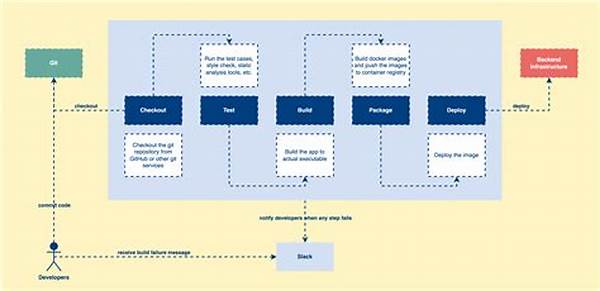
Furthermore, continuous integration facilitates the adoption of a rapid development cycle, allowing multiple development teams to work concurrently on different microservices without causing integration chaos. By automating the process of building, testing, and integrating code changes, continuous integration in microservices architecture reduces the time between code commits and deployment. This not only accelerates the delivery of new features but also ensures that the integrated codebase remains robust, secure, and production-ready.
Moreover, continuous integration in microservices architecture plays a crucial role in maintaining consistency across various services by ensuring that standardized coding practices and testing protocols are adhered to. This uniformity is vital in a microservices environment, where diverse teams may be responsible for different service components. The implementation of continuous integration thus fosters a culture of quality, precision, and collaboration, driving the successful deployment and operation of microservices solutions.
Key Practices of Continuous Integration in Microservices
1. Automated Testing: Automating the testing process is integral to continuous integration in microservices architecture. It ensures that each code change is validated for functionality and compatibility.
2. Frequent Commits: By committing code frequently, developers ensure that continuous integration in microservices architecture detects conflicts early, reducing the risk of extensive rework.
3. Consistent Codebase: Maintaining a consistent and up-to-date codebase is a crucial practice, ensuring that continuous integration in microservices architecture progresses smoothly without integration issues.
4. Feedback Mechanisms: Effective feedback mechanisms expedite the identification and resolution of issues, a vital component of continuous integration in microservices architecture.
5. Environment Parity: Ensuring development and production parity helps continuous integration in microservices architecture by minimizing differences that could lead to deployment issues.
Challenges and Solutions in Continuous Integration
Continuous integration in microservices architecture, while transformative, is not devoid of challenges. One of the prominent hurdles is the complexity introduced by having numerous microservices. Each service might have distinct dependencies, requiring meticulous management to avoid integration conflicts. To address this, utilizing containerization technologies like Docker can standardize deployment environments, ensuring environment consistency across all stages of development and deployment.
Another challenge in continuous integration within microservices architecture is effective testing. Given the distributed nature of microservices, ensuring comprehensive test coverage that mimics real-world usage scenarios is crucial. Utilizing automated testing frameworks and tools that support behavior-driven development can significantly enhance test accuracy and reliability, thus strengthening the overall effectiveness of continuous integration processes.
Moreover, the human factor remains a significant challenge, as developers may need to adapt to new tools and workflows necessitated by continuous integration. Addressing this requires comprehensive training and a shift in organizational culture to foster a supportive environment that embraces automation and continuous improvement. Succinctly, while continuous integration presents challenges, with meticulous planning and the right tools, organizations can overcome these obstacles to achieve seamless integration in their microservices architecture.
Benefits of Implementing Continuous Integration
1. Enhanced Collaboration: Continuous integration in microservices architecture fosters improved collaboration among development teams, enhancing code quality.
2. Rapid Feedback: By automating feedback loops, continuous integration ensures quicker identification and resolution of issues, ensuring robust microservices.
3. Reduced Integration Risks: Integrating frequently reduces the size and complexity of code changes, minimizing the risks of integration conflicts.
4. Scalability: The architecture benefits from superior scalability as services can be independently developed, deployed, and scaled.
Read Now : Big Data Architecture Best Practices
5. Improved Deployment Speed: Continuous integration leads to faster and more reliable deployments by automating significant portions of the development cycle.
6. Fault Tolerance: Systems benefit from increased fault tolerance due to frequent testing and integration, identifying issues before reaching production.
7. Standardization: Continuous integration enforces standard practices across services, ensuring consistency and compliance with organizational guidelines.
8. Simplified Maintenance: Regular integration simplifies maintenance by ensuring that the codebase remains manageable and up-to-date.
9. Cost Efficiency: The streamlined processes reduce development and operational costs through efficient resource utilization.
10. Customer Satisfaction: Ultimately, continuous integration in microservices architecture leads to improved software quality, meeting customer needs effectively.
Strategic Implementation Approaches
Implementing continuous integration in microservices architecture requires a strategic approach to reap its full benefits. An essential consideration is the choice of tools and technologies. Popular CI/CD tools like Jenkins, Travis CI, and CircleCI can automate the integration and deployment processes, offering a robust backbone for microservices development. Besides tooling, instilling a culture of regular feedback and open communication is pivotal for addressing integration and deployment challenges in real-time.
Another strategic approach involves prioritizing test automation. Given the complexity inherent in microservices, comprehensive automated testing ensures that each microservice adheres to quality benchmarks prior to integration. Alongside testing, clear documentation of the CI process is essential. Documentation serves as a guide for developers, easing the onboarding process for new team members while providing a reference for resolving integration conflicts.
Further, continuous integration in microservices architecture should accommodate scalability and flexibility to adapt to evolving project requirements. Utilizing modular and containerized environments facilitates seamless integration across diverse system components. By following a strategic approach that combines tool selection, culture, automation, and flexibility, organizations can maximize the effectiveness of continuous integration, ensuring successful microservices deployment and management.
Addressing Common Pitfalls
Continuous integration in microservices architecture entails addressing common pitfalls that might impede its successful implementation. One common issue is siloed teams, which can lead to integration problems. Encouraging cross-functional collaboration and ensuring synchronized workflows are effective strategies to overcome this barrier. Additionally, setting realistic and measurable goals helps align team efforts towards achieving continuous integration objectives.
Another pitfall is inadequate version control practices. Comprehensive version control is mandatory to track changes and coordinate among multiple contributors effectively. Incorporating branch management strategies further facilitates smoother code integration. Finally, resistance to change among developers may hinder the adoption of new tools and practices. Ensuring adequate training and positioning continuous integration as a value-adding process can alleviate this resistance. Overall, proactive management of these pitfalls facilitates seamless continuous integration in microservices architecture.
Conclusion
In conclusion, continuous integration in microservices architecture represents a profound advancement in the realm of software development. By streamlining the integration of disparate microservices, it enhances collaboration, accelerates deployment, and bolsters software quality. Through the adoption of automated tools and strategic approaches, organizations can address the associated challenges, culminating in robust and scalable software solutions.
Moreover, the implementation of continuous integration fosters a culture of innovation and excellence, aligning technology operations with business objectives. As microservices architecture continues to evolve, continuous integration remains an indispensable component, underscoring its relevance in modern software development paradigms. Ultimately, embracing continuous integration ensures adaptability, efficiency, and sustained success in the dynamic landscape of microservices.


